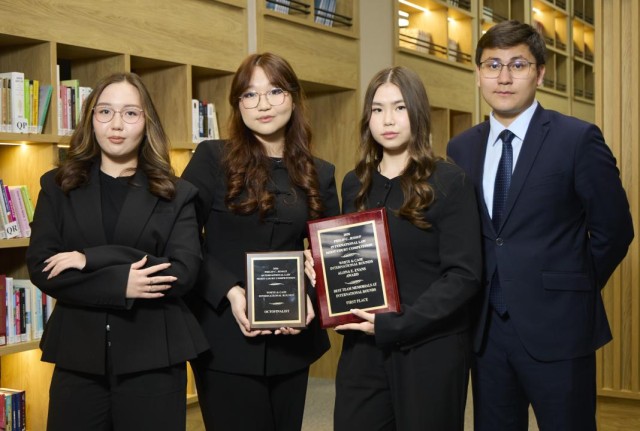



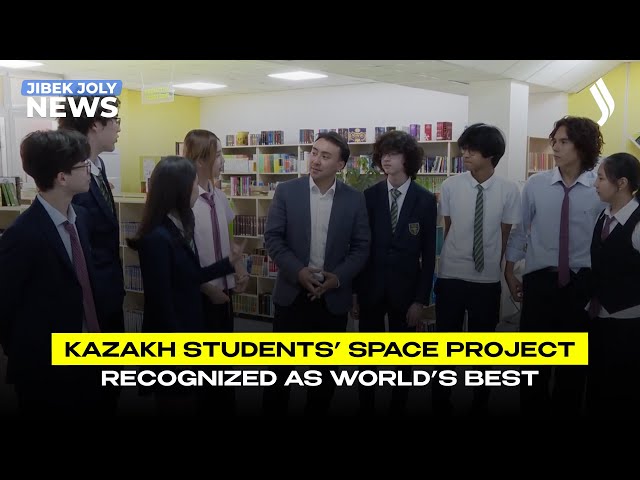
Kazakh school students know how to harness energy from Jupiter’s resources. The project «Icarus: Baiterek» by students of the Nazarbayev Intellectual School in Almaty won the international Space Settlement Contest. Over 23,000 students from more than 30 countries participated in this prestigious science and engineering competition. The Kazakh team designed a self-sustaining station in orbit around Callisto, one of Jupiter’s moons. Its concept includes artificial gravity, a water purification system, and oxygen production using chlorella. The station will allow the study of life in space and help tackle global challenges. For example, the team proposed reducing dependence on fossil fuels by extracting alternative energy sources from the upper layers of the gas giant, adapting and transporting them to Earth via shuttles.
«We chose Jupiter because, in our view, it offers significant advantages: the planet has a large number of moons. They are located close to each other, making it convenient to travel between them to extract various resources. Jupiter’s moons contain everything - from water to minerals and energy. I believe that in 50 to 100 years, this idea will become highly relevant, practical, and quite feasible,» said NIS student Sabyrzhan Inkarbek, Almaty.
Although the Moon and Mars remain the primary targets of exploration, modern space programs are actively expanding the horizons of research. In this context, Kazakh students proposed harnessing the powerful atmospheric processes of the solar system’s largest planet. Students from Almaty designed a «gateway» to deep space that would allow humanity to establish a presence far from Earth and study rare minerals.
«Students who are just starting out in science often try to distinguish themselves in some way. Here, creativity really comes into play. The fact that they propose a concept not previously considered by other scientists shows that they are putting forward the idea that, after all, it is possible,» noted NIS Principal Yerbolat Niyatbay, Almaty.
Now, the young engineers will travel to the U.S., where they will present their projects to global experts at the International Space Development Conference in June.

Related Articles