

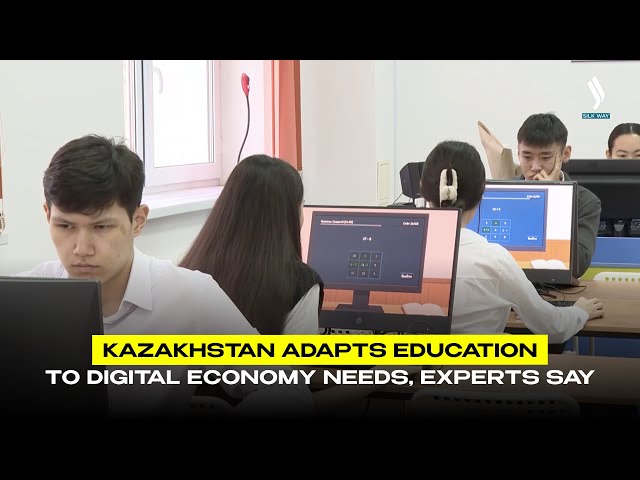
The decision to integrate artificial intelligence into Kazakhstan’s secondary education system, initiated by President Kassym-Jomart Tokayev, is receiving support from international experts and IT analysts. They view it as a strategically important step toward transitioning to the economy of the future. Eric Gordon, a professor at Boston University, noted that the introduction of AI is aimed at transforming the educational model and developing digital skills among school students. Therefore, the approach to learning will shift from memorizing information to managing it. The expert also emphasized that success depends not only on technology. A comprehensive approach, including teacher training, the development of digital infrastructure in schools, and the establishment of safe rules and standards for AI use, plays a key role.
«One is a kind of global AI arms race, where every country is trying to position themselves to be competitive, which makes sense with any new technology that happens. On the other hand, there is a need for some defensive action. Because if AI goes unchecked, it can compromise young people’s learning. So it’s really important that both of those things are pursued at the same time,» Gordon said.
Peter Norvig, a researcher at Stanford University and Director of Research at Google, notes that the use of AI in schools will make every subject more engaging and adaptable, while also enabling students to develop more practical skills. According to him, students will be able to independently explore new topics and conduct full-scale scientific experiments. In addition, the combination of digital solutions, effective teaching methods, and active teacher involvement is key to bridging the gap between urban and rural schools.
«I like what’s being done. I think that’s great. I
think the President is very forward-thinking and has an ambitious agenda. You
know, instead of just doing a homework assignment or writing an essay, you can
do a real science experiment, or you can do some simulation, or you can do a
much more ambitious project than you could do in the past. And I think also, I
think we’ll probably see kind of breaking down the barriers: now we have
schools separated into now we’re doing history, now we’re doing biology, and so
on. And I see more interaction between those various fields. And I think AI can
really help make those connections and make it more flexible. So, you know,
each student can be doing what they’re excited about rather than having every
student doing the same thing,» Norvig said.

Related Articles