


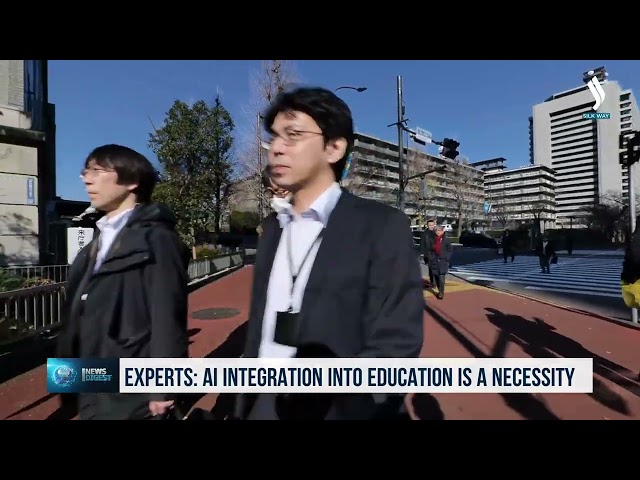
Kazakhstan is on the verge of transitioning its school education system to a new model incorporating artificial intelligence. The President previously signed the relevant decree. The country is aligning its education reforms with global trends. Singapore, South Korea, China, and Japan are already actively using adaptive platforms for lesson personalization, algorithms for assessing students’ skills, and the integration of the fundamentals of AI into mandatory school curricula. For example, Japan has introduced the GIGA School Program. Every student is provided with a personal tablet or laptop. These devices are used not only for reading but also as interactive workbooks equipped with intelligent systems that analyze students’ answers and suggest additional materials when a learner struggles with a specific topic. There are also limitations. In lower grades, children are introduced only to the basics of AI, while its use as a tool begins at the middle-school level. According to experts, Kazakhstan is also following this path. At the same time, artificial intelligence must be properly integrated into the learning process. This requires two key approaches.
«The first direction is
the use of artificial intelligence as a student tutor — a personal tutor. Each student is tracked by AI,
including their academic performance and level of preparedness. The second
direction is an assistant or support tool for the teacher. This reduces the
teacher’s administrative and routine workload. As a result, teachers can use
the freed-up time, up to 30–50%, for educational and developmental work with
students,» said
Serik Meirmanov, Vice President
of Ritsumeikan
Asia Pacific University
in Japan.

Related Articles