

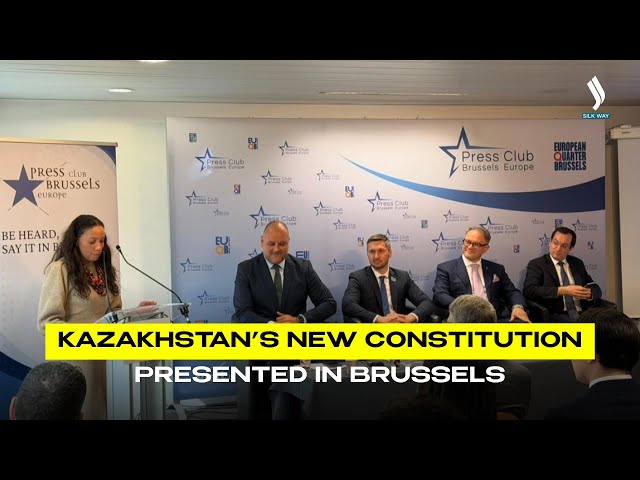
Kazakhstan’s new Constitution was discussed in
Belgium. At the Brussels Press Club, representatives of the European Commission
and the EU Council, as well as diplomats and analysts, were briefed on the key
amendments to the country’s Basic Law. Senate member Evgeny Bolgert and the
Head of the Mission of Kazakhstan to the European Union, Ambassador Roman
Vassilenko, noted that the new Constitution is aimed at a clearer distribution
of powers among the government branches. They highlighted the strengthening of
the Parliament’s role, the expansion of parliamentary oversight mechanisms, and
additional guarantees for the independence of the judicial system.
«The People’s Council is becoming a kind of successor,
first and foremost, to the Assembly of the People of Kazakhstan. Secondly, it is
the successful work of the National Kurultai. It also reflects the experience
of interaction between civil society and the state. The People’s Council will
not adopt laws, but following internal discussions, it will have the right to
initiate the drafting of certain laws that society needs, which should then be
considered and adopted by the Kurultai,» noted Evgeny
Bolgert, a member of the Senate, the Upper House of the Kazakh Parliament.
The meeting also focused on broadening citizens’ participation in public administration, which is being implemented through new consultative formats and mechanisms of public dialogue. Discussions further covered key priorities such as the rule of law and greater transparency of public institutions. Additionally, participants addressed human rights in the digital sphere, environmental responsibility, and social policy. These provisions have been enshrined in the new Constitution.
«I think, I commend the great transformation at the constitutional
architecture. And I think it’s a great moment for Kazakhstan, first of all,
because Kazakhstan is the most prosperous Central Asia country. So, my interest
is to see how this new architecture will impact the economy, how this new
architecture will impact the dynamicity of the market and the production of the
industries, how this new architecture will help Kazakhstan in this momentum to
be the leader of the Central Asian countries,» said Maurizio Geri, an expert in international relations.
Participants expressed the view that the constitutional reforms could strengthen investor confidence, enhance regulatory predictability, and open up new opportunities for cooperation between Kazakhstan and the EU.
«The constitutional referendum in Kazakhstan
represents a significant moment in the development of the country. The high
level of participation and engagement is essential for shaping the reform
process. They will contribute to a more stable, transparent and predictable
environment, key elements for strengthening long-term cooperation between
Kazakhstan and European Union,» noted Marilyn Josefson, Advisor to the President of the European Council
for relations with Central Asia.

Related Articles